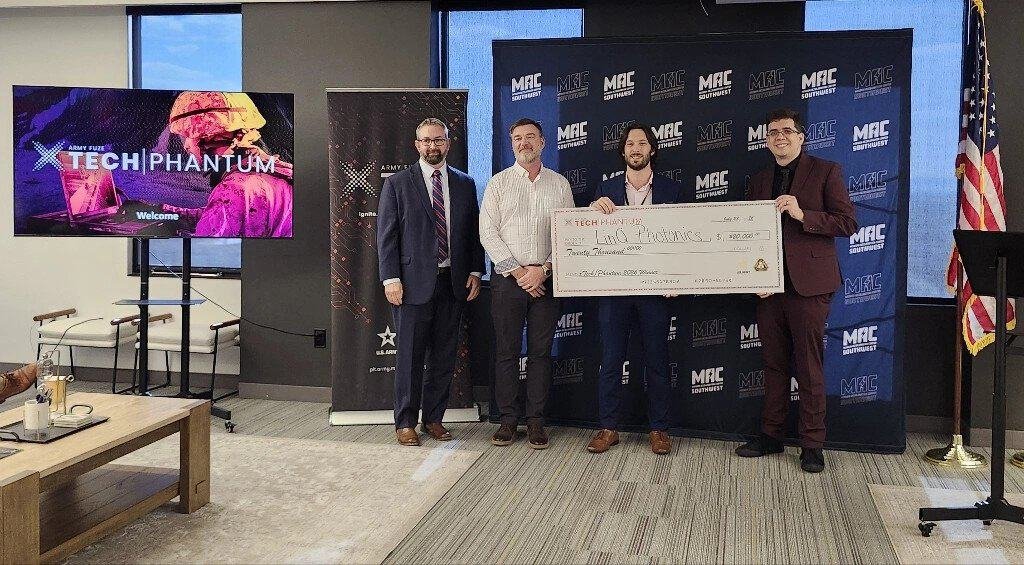
LinQ Photonics Selected Winner of U.S. Army xTech|Phantum Competition
Back to recent news articles
LinQ Photonics has been selected as a winner of the U.S. Army’s xTech|Phantum competition for developing technology which enables operators to establish alternative communication pathways in environments where conventional radio-frequency systems may be congested, detected, disrupted or denied.
“Modern military operations cannot depend upon a single communications modality,” said Caleb Rohn, Co-Founder and Chief Executive Officer of LinQ Photonics. “This award validates both the urgency of the Army’s requirement and LinQ’s approach: a modular coherent photonics platform that can be adapted across precision sensing, measurement and resilient communications. We look forward to working directly with Army stakeholders to advance the technology towards a field-relevant capability.”
The program was created by the US Army and administered by the Office of the Assistant Secretary of the Army for Acquisition, Logistics and Technology in partnership with the Army Directorate for Strategy and Transformation, to connect small businesses developing technologies with potential military applications, connect non-traditional small businesses with Army subject-matter experts and accelerate promising capabilities into the defense acquisition ecosystem.
As an xTech|Phantum winner, LinQ will receive a $20,000 cash prize and the opportunity to participate in a Phase I Army Small Business Innovation Research grant valued at up to $300,000 to support a proof-of-concept development over a period of six months.
The win represents an important expansion of LinQ’s defense and communications portfolio, validating a foundational technology that supports LinQ’s broader platform strategy: developing a common, modular core that can be configured for a wide range of use cases such as counter-UAS, infrastructure health monitoring, and more.
“This is more than recognition of a single product,” Rohn added. “It demonstrates the versatility of the coherent technology platform we have built and its ability to address multiple operational problems without requiring an entirely new system architecture for each application. We couldn’t have accomplished the development of this technology without Montana’s amazing photonics community and are looking forward to sharing more of what we have in store. We have some very exciting developments on the horizon.”
LinQ will now continue technical engagement with Army stakeholders while preparing its Phase I SBIR proposal and development roadmap.
For more information about LinQ Photonics please visit linqphotonics.com or reach out to calebrohn@linqphotonics.com